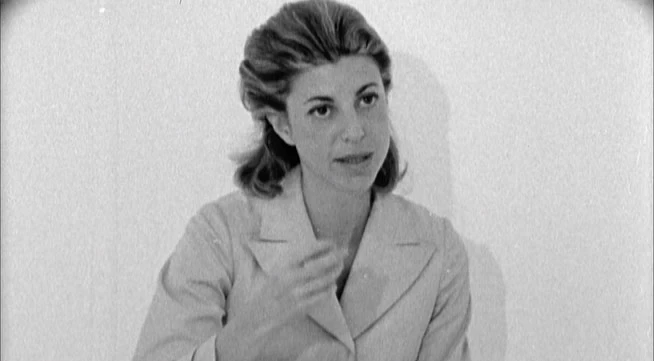
Artillery Magazine joins Now Instant for a special presentation of Emile de Antonio's 1973 documentary Painters Painting, featuring studio visits and interviews with Robert Rauschenberg, Willem de Kooning, Jasper Johns, Helen Frankenthaler, Frank Stella, Barnett Newman, Hans Hofmann, Jules Olitski, Philip Pavia, Larry Poons, Robert Motherwell, Kenneth Noland, and Andy Warhol, who famously said, “Everything I learned about painting, I learned from De.”
The screening will be preceded, and followed by a reception hosted with Artillery.
Painters Painting
“I had struggled long in the space between my politics and my enjoyment and support of contemporary New York painting. I loved the painting and tried to live my politics. My wife, Terry, suggested a film whose subject would be the New York painting of my time. It might resolve my problem, she said...
I disliked the films on painting that I knew. They were either arty, narrated in a gush of reverence as if painting were made among angelic orders, or filmed with violent, brainless zooms on Apollo’s navel, a celebration of the camera over the god. They revealed nothing at all about how or why a painting was made. Dislike of other films is not a bad place for a film to begin. There were problems nonetheless. The works were strewn across the world in different collections, and I didn’t fancy trekking to L.A., Japan, Germany, and Italy for collectors who thought art was collecting.
Henry Geldzahler and the Metropolitan Museum of Art solved that problem in 1969 with an exhibition for the Met’s centennial called New York Painting and Sculpture: 1940–1970. Henry collected 408 works by forty-three artists. The press called it “Henry's show” and treated it like a campy scandal, which made it look like one. It wasn’t. It was the best show of modern New York painting ever hung. Contemporary works of such quality will never again be brought together on such a scale and in such appropriately grand space, perfect for filming. Modern art is more fragile than that of the Renaissance and insurance costs are too high. The paint and parts are inferior, particularly in the early works of many painters. The big works don’t move easily and big collages contain elements never made to move...
I met with Henry and Ashton Hawkins of the Met and we agreed that my company, Turin Film Corp., would have the exclusive right to film the exhibition. One stipulation on their part: we could film only at night when the museum was deserted and we had to pay to have three armed museum guards watch over us to preserve works from desecration. We spent many winter nights filming, and the guards were successful in preventing me from stealing Aristotle Contemplating the Bust of Homer. After I sent over a few beers and big meaty sandwiches, their chief said to me, “You making a film?” “Yeah.” “Why film this garbage? [pointing to a contemporary artwork] It’s awful. Listen, take your crew down there about ten galleries and you can film Rembrandt.” Weeks and hundreds of beers later, he came over and pointed at a de Kooning collage: “You know, that’s not too bad.”
I had always liked black-and-white film better than color. I liked its tone, shades, limits. I decided to film all the people in black and white 16mm and all the paintings in 35mm color. The film crew for Painters Painting was Ed Emshwiller, camera; Mary Lampson, sound; Marc Weiss, assistant camera. Hundreds of hours were spent lighting and filming the works I chose. Modern painting is more difficult to film than older work because often the frames are metal. Under intense film lighting these cause “hot spots” that distort the image. All the beers and sandwiches proved useful in the late hours of the night as Emshwiller and I attached gaffer tape over frames to neutralize them. The guards looked away.
The film is personal. Why did I leave out Rothko, Gottlieb, Kline? I loved their work but loved Pollock, de Kooning, and Newman more. In Sagaponack one winter, a good and well-known painter who was in neither the show nor the film said to me over many drinks, “You know, I really like your political films but don’t like Painters Painting.” “Because you’re not in it?” “Of course.”
— Emile de Antonio, introduction to Painters Painting: A Candid History of the Modern Art Scene, 1940–1970 (New York: Abbeville Press, 1984).
Please note: seating is limited. Box Office opens thirty minutes prior to the listed showtime. Guests may add their name to the standby list upon arrival. Online ticket sales will be honored up until 15 minutes after the scheduled showtime; at that time, any unclaimed seats will be released for in-store purchase on a first-come, first-served basis. All Sales Final.