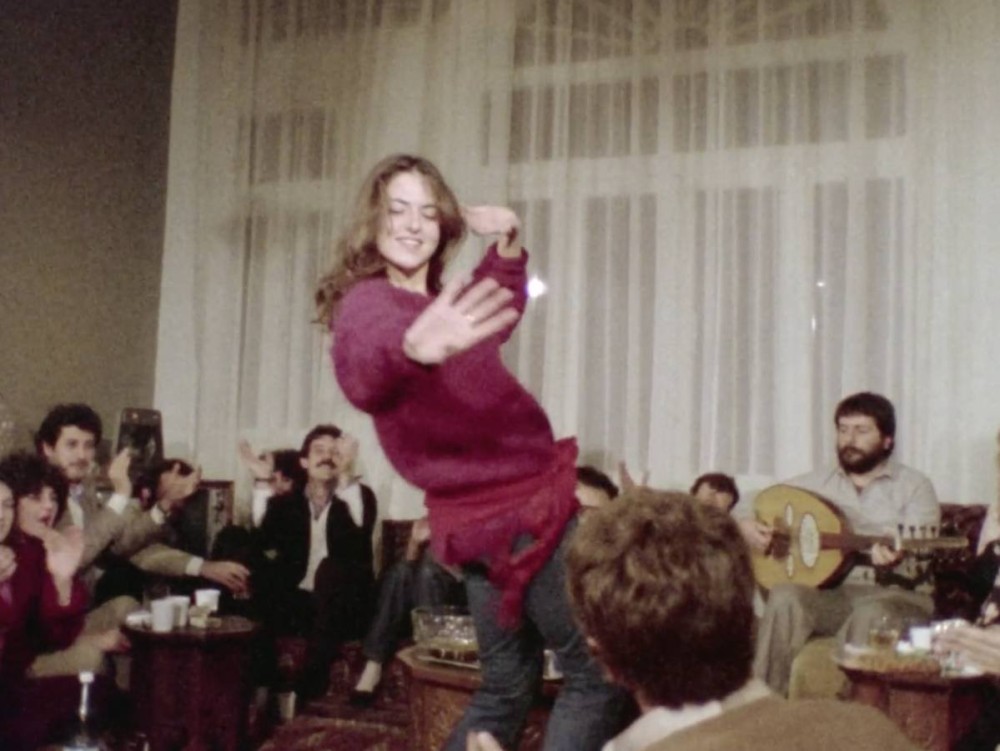
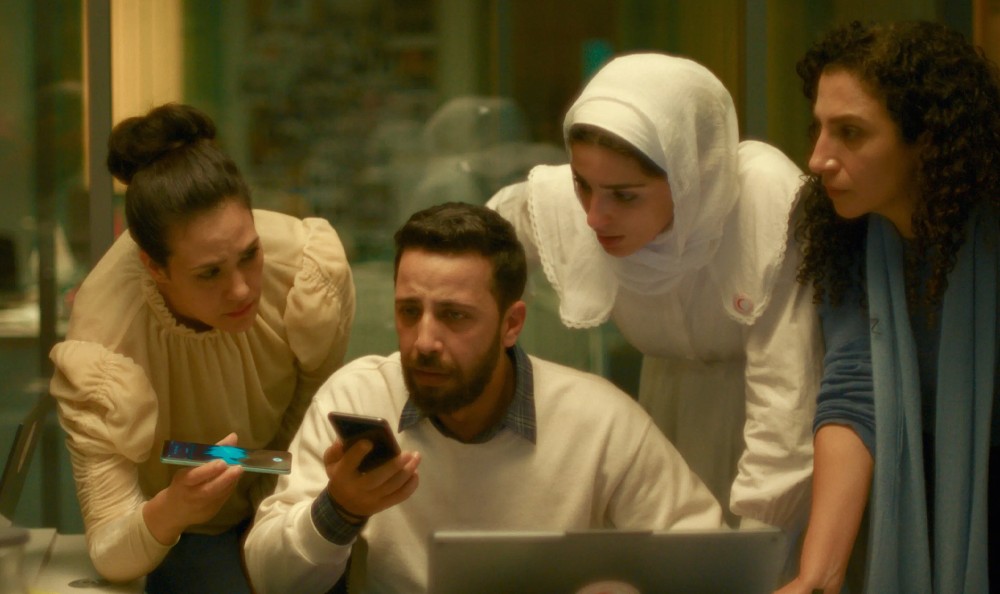
Willa presents a special presentation of The Voice of Hind Rajab, with a pre-taped introduction from director Kaouther Ben Hania. Artists Sadia Quddus and Mashinka Firunts Hakopian will lead a post-screening group conversation with the audience. This event was co-organized by Sadia Quddus and Mindy Seu.
The Voice of Hind Rajab
January 29, 2024. Red Crescent volunteers receive an emergency call. A 5-year-old girl is trapped in a car under fire in Gaza, pleading for rescue. While trying to keep her on the line, they do everything they can to get an ambulance to her. Her name was Hind Rajab.
A Voice, Immortal
“People say silence is a sign of consent. What if I’m not allowed to speak, my tongue severed, my mouth sewn shut?”
— Mosab Abu Taha, Things You May Find Hidden in My Ear: Poems From Gaza
“We live behind a wall of unspeakable torment that few outside can penetrate. Our voices feel like faint resonances, lost in the vastness of a world unwilling or unable to listen.”
— Taqwa Ahmed Alwawi, “In Gaza, We Are Literally Losing Our Ability to Speak”
A presence without a body. An image constructed through negative space. A soul carried by sound.
The voice of Hind “Hanood” Rajab Hamada was first transmitted to the world via social media on January 29, 2024, by the Palestinian Red Crescent Society (PRCS). It was shared in a desperate attempt to encourage international intervention to save a five year old child trapped in a car filled with the bodies of her dead relatives in Gaza, gunned down by the Israeli Defense Forces (IDF). She became known by her arresting pleas to be saved, her voice memorized and her name adopted by activists, artists, and enraged citizens all over the world.
It is this voice that continues to reverberate through time and space, immortalized through The Voice of Hind Rajab. Operating within an algorithmic media landscape flooded with documented war crimes, authoritarian propaganda, generative slop, and a global audience suffering from a deep disillusionment with images, the film makes the bold decision to portray Hind primarily through her voice in place of recreating the scenes of her suffering.
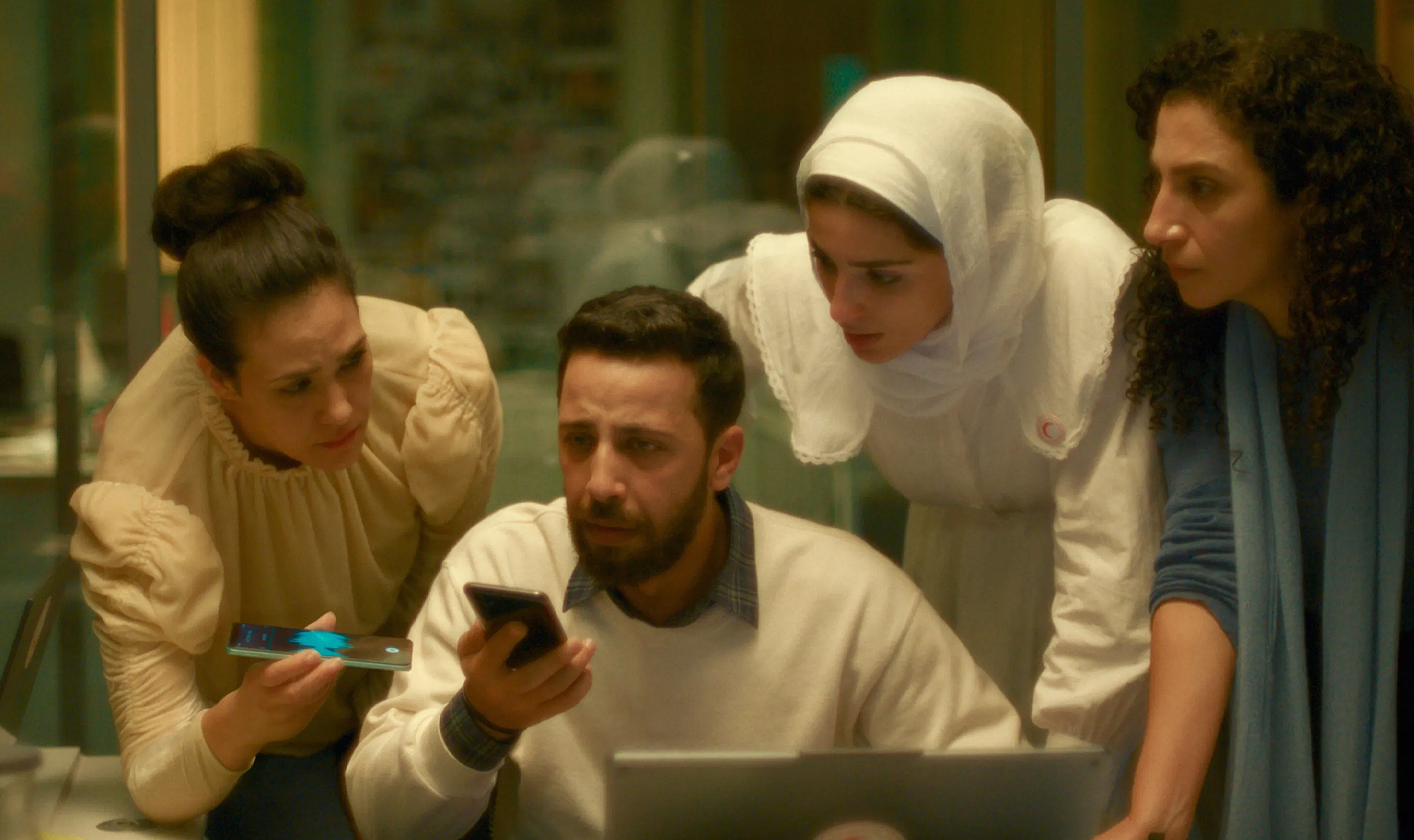
The Voice of Hind Rajab is a hybrid documentary, mixing elements of traditional documentary and narrative cinema to form an intimate dramatisation. Director Kaouther Ben Hania blends rich cinematography and dramatic reconstruction with real audio files and actual documented footage from the incident. The film is set in the Palestinian Red Crescent’s office in Ramallah, following four Red Crescent workers: Omar, Rana, Nisreen, and Mahdi, as they work through the convoluted layers of bureaucracy and intense waves of emotional turmoil as they fight to rescue Hind.
In an interview with John Horn for the Oscars Academy Conversations, Ben Hania shares that she focuses on the call center rather than recreating Hind’s surroundings because she was interested in illustrating “another kind of violence, a system violence.” We follow the frustrations and devastation as endless obstacles halt a rescue by a PRCS ambulance located 8 minutes away from Hind. We watch Omar’s rage at Mahdi’s inability to secure permissions for a rescue, and Mahdi’s own simmering frustration as he diagrams the process of permissions with a dry erase marker. We watch Rana pass out from exhaustion while refusing to give up the phone, and as Nisreen’s entire bearing transforms when she speaks to Hind herself for the first time.
For three hours, while Hind remains under fire, Mahdi works tirelessly through this convoluted permissions chain: PCRS first to the Red Cross, who reaches out from there to the Coordinator of Government Activities in the Territories (COGAT) within the Israeli Ministry of Defense, who then follows up with the Israeli military forces within Gaza, who will provide a safe route—but only back in the same exact direction: IDF to COGAT to Red Cross to PCRS. In addition, the Israeli army has its own bureaucratic process they go through before giving the PCRS the greenlight to actually execute the rescue mission. Skipping a single step of this process results in accusations of violations, and the excruciating cycle begins again.
By watching these aid workers, we are made acutely aware of the strangling impotence of Western aid infrastructure and the inhumanity of the IDF and occupation forces. These are the facts the film actively illustrates in the prime immediacy of the moment.
We encounter Hind only through secondary means, namely her voice, and an animated waveform that accompanies her as she speaks. Before her photograph is revealed, she is seen as pure data. The film recasts everyone but Hind, her cousin Layan, and her mother and brother. When the PRCS aid workers finally discover Hind’s identity and photo, we see them hold up printed images of Hind herself. These same images have become iconic as they’ve been shared and reshared across the internet: a bright little girl in her preschool graduation gown, proudly grasping her graduation cap; smiling while sitting in a child’s swing, flowers in her hair, pink shirt, pink walls, pink flowers; dressed in a pink dress with puffed sleeves, her hair gathered up in a sequined crown; a photo from school, her hair in braids pinned with flowers, one hand in a thumbs up gesture, the other showing off a cup full of chocolates.
The Voice of Hind Rajab reconstructs presence around absence. Despite already knowing Hind’s ultimate fate, that she was found twelve days later in a car punctured by 355 bullets, the audience is pulled into this narrative of desperation and hope. Through multiple viewings, I find myself hoping, almost believing, that this time they will save her. We feel the peaks and valleys of joy and anguish alongside Rana, Omar, Nisreen, and Mahdi, experiencing their longing and devastation, sometimes quite literally through their eyes in point-of-view shots that align us with the workers.
Between recreations, Ben Hania also crosscuts extradiegetic sequences of the cast—Saja Kilani (Rana), Motaz Malhees (Omar), Clara Khoury (Nisreen), and Amer Hlehel (Mahdi)—quietly experiencing the audio clips, including Hind’s voice with the actual aid workers. The audience becomes aware that the actors, like us, are also responding to these shattering archives.
Saja Kilani and Motaz Malhees have both shared in interviews that during their scenes, they believed they could save Hind. And yet the film concludes as reality does, with no alternate timeline, no happy ending. The grim truth, that we collectively failed a child begging to live, still stands.
How does hearing the real Hind Rajab’s voice, not on social media as a news clip, but in a cinematic dramatisation, affect the audience? Without a visual recreation of Hind’s death, does the film shield the audience from the true horror of her experience? What purpose would it serve to see violence meted out onto another child’s body, even if only performatively? What would it mean for the memory of Hind to have another girl repeat the final moments of her life?
Visceral brutality no longer moves any needle. A near constant stream of documentation of the brutality endured by Palestinians across Gaza and the West Bank has flooded the internet for the last three years, without manifesting any material change. Images of dead children sit between ads for skincare products and influencer content in a vast ocean of visual media. And a fragile ceasefire is the result, existing only in name to mask continued occupation, blockade, torture, and death.
In a post-truth, AI slop-fueled new media landscape, when the once-veracity of visuals can no longer be relied upon and our consciousness is over-saturated with images of violence, the use of Hind’s recorded voice cuts through our apathy and indifference. This young, plaintive voice pierces through the wash of archival violence that numbs even the most sympathetic audience. This numbness is not one of the heart, but rather one of the eyes. To have been online in the last few years is to have been the recipient of a coordinated barrage of visual overwhelm in the American media landscape. Ben Hania’s decision to focus entirely on Hind’s voice is a strategic approach to cutting through this attention crisis—by denying the brutal visuals altogether.
This media ecosystem has a tendency to flatten the deaths of Palestinians, young and old, into numbers; faceless, nameless, story-less, just data to populate a news article. All of their stories deserve a film, deserve to be heard and reckoned with, and for the world to know that even a single one of these stories is a rare experience. We should feel implicated by every single one, but the image of a broken body has simply become a product for consumption, something to be mocked and promoted by occupying forces and their supporters, and devoured by the merciless calculations of the algorithm that rules our collective attention and focus. Our media landscape survives on the escalation of ever more sensationalized images. We become continuously numb to such extremes, spurring ever more intensifications, a vicious cycle of image-based calculation.
By paring this violence back and refusing to recreate the image of Hind’s death, the audio reconstructs the last harrowing moments of Hind’s life almost entirely through echoes, forcing the audience to become active participants and reconstruct the image within our own imaginations. To opt out, to refuse to feed this visual machine is a radical step in denying the machinic hunger that has taken control of the way we engage with images. It allows us to witness without being a means for profit. In a way, this is a return to how humanity has always borne grief, embodied and deeply felt in the mind and the heart.
Film is a space where the body can transcend. In viewing the film, listening to the voices and seeing the bodies on-screen, an audience becomes a collective witness, holding space for these tragic events. Hind’s presence itself is beyond spectral, beyond a haunting. By hearing Hind’s actual voice and her revelations about her life, that she is in the Butterfly class, that she cannot speak because she bleeds when she talks, that she doesn’t want to inconvenience her mother with a bloodied shirt, that she wants Rana’s husband to bring Rana to Gaza, we form her being in our mind’s eye. Hind is not a character rebuilt on screen, but a spirit who lives in our hearts. It is through her immateriality, as pure audio—discounting the physicality of data—that Hind “Hanood” Rajab Hamada is sublimated as pure presence, as a life immortalized, enduring in a world where images are temporary and shifting. She is a person constructed from her own absence, energy exerted over corporeal matter, a force that quite literally reverberates across space.
After her first documentary, Tank (2003), was labeled propaganda, Palestinian filmmaker Larissa Sansour has shared often in interviews that she shifted her work from documentary to science fiction because reality was too difficult for anyone to believe or trust, and that only fiction could illustrate the truth of the conditions Palestinians endure. In The Voice of Hind Rajab, Ben Hania uses the blend of the real with cinematic recreation to weave a narrative that is both true and more than true, an active narrative with a protagonist at its center whom we can only know through her own words.
And yet, some images continue to hold an arresting power. It isn’t until the end, when we see footage of the wreckage of the ambulance and of the Hamada family car, of Hind’s mother slowly approaching a heartbreakingly small, shrouded body, the sequined pink and turquoise backpack in the wreckage of the trunk of a car filled with blurred corpses, of a family trying only to live, that we are confronted with the obscenity of a reality that is not yet over. And in that moment, absence and presence, audio and image, coalesce to return us to our brutal reality: that of a world that has closed its eyes to the horrors of a murder such as this, and has fought justice every step of the way.
Written by Sadia Quddus
Edited by Mila Zuo & Mindy Seu
Please note: seating is limited. Box Office opens thirty minutes prior to the listed showtime. Guests may add their name to the standby list upon arrival. Online ticket sales will be honored up until 15 minutes after the scheduled showtime; at that time, any unclaimed seats will be released for in-store purchase on a first-come, first-served basis. All Sales Final.